
●Zero-upfront-cost venue solution
Revenue-Share Smart Lockers for Venues
Basecamp funds, installs, owns and maintains smart rental lockers for qualifying venues. You provide the right location; together, we share the net profit they generate.
Updated 14 August 2026 · Basecamp Lockers
Revenue-share lockers are smart rental lockers supplied without an upfront purchase cost to an approved host venue. Basecamp invests in the equipment and manages the technical service. Agreed direct operating costs are deducted from rental income, and the remaining net profit is shared under the commercial terms agreed for that venue.
This model is also described as profit-share lockers, zero-CAPEX venue lockers or free-to-install smart lockers. It is not automatically available to every location: Basecamp first checks that expected demand, available space and the operating environment support a viable long-term partnership.
●The model
What are revenue-share lockers?
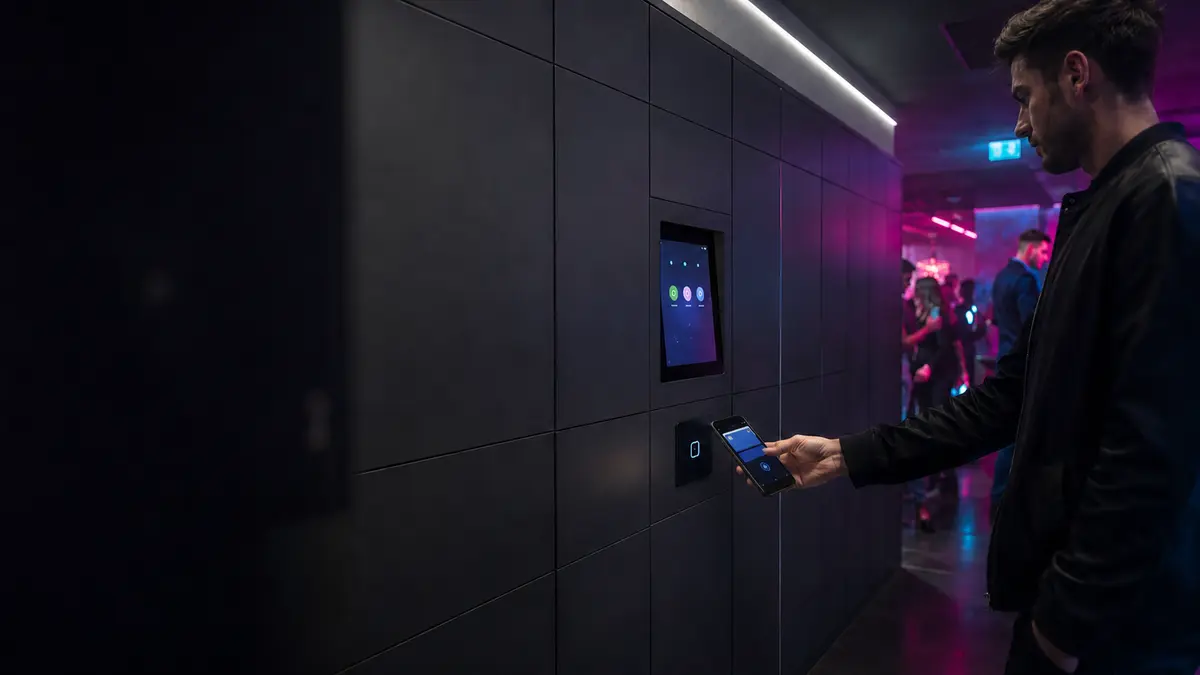
A revenue-share locker agreement is a partnership between Basecamp Lockers and a host venue. Instead of purchasing or leasing a smart locker system, the venue provides a suitable position and makes the service available to visitors. Guests pay to rent a locker, normally through a self-service touchscreen, contactless payment terminal or mobile booking journey.
Basecamp funds and owns the agreed installation, operates the technology and maintains the system. The venue earns an agreed share of the net profit while adding a useful visitor service without committing capital to the locker purchase.
●Worked example
How does Basecamp’s 50/50 net-profit model work?
Basecamp aims to structure suitable partnerships around an equal share of the net profit. The precise split and direct operating costs are assessed for each venue because rental price, turns per day, opening pattern, installation and support requirements all affect the commercial case.
- Illustrative gross locker income
- £3,000
- Agreed direct operating costs
- −£350
- Net profit available to share
- £2,650
- Illustrative venue share
- £1,325
- Illustrative Basecamp share
- £1,325
This is an example, not a guaranteed offer or income forecast. The final commercial arrangement is confirmed in the venue proposal and host agreement.
●Responsibilities
What does Basecamp pay for?
For an approved revenue-share installation, Basecamp normally funds and provides:
- ✓Locker cabinets and electronic locking hardware
- ✓Touchscreen, payment and booking technology
- ✓Design and agreed standard installation
- ✓Software, connectivity and system monitoring
- ✓Technical support, repairs and maintenance
- ✓Performance and revenue reporting
What does the venue provide?
The venue does not pay an upfront locker purchase price or standard installation cost. It normally provides:
- ✓A visible, accessible and suitable floor location
- ✓Electricity and any agreed local enabling works
- ✓Installation and maintenance access
- ✓Promotion of the service to visitors
- ✓First-line help for customers at the venue
- ✓A safe operating environment for the equipment
Any exceptional building works, landlord requirements or site-specific costs are identified and agreed before the project proceeds.
●Income potential
How much revenue can smart lockers generate?
There is no universal revenue figure. A useful first estimate is:
Available lockers × average rentals per day × average rental price × opening days
For example, 25 paid rentals per day at an average of £4 over 30 opening days would produce £3,000 in gross monthly locker income. Actual performance will vary with footfall, bag-carrying visitors, dwell time, weather, event schedules, the locker-size mix, pricing, visibility and the number of times each locker turns over.
Our calculator lets you test those variables rather than relying on a headline income claim.
●Venue fit
What sort of venue works best?
The strongest revenue-share opportunities have regular visitor traffic and a clear reason for guests to store coats, bags, backpacks or luggage. They also have a prominent locker position, consistent opening days and a team willing to make visitors aware of the service.
Often a strong fit
- ✓Nightclubs and live music venues
- ✓Museums and visitor attractions
- ✓Immersive and entertainment venues
- ✓Hotels, hostels and aparthotels
- ✓Event spaces and leisure destinations
What Basecamp assesses
- ✓Annual and peak-day footfall
- ✓Likely rentals per locker per day
- ✓Opening days, dwell time and seasonality
- ✓Rental price and alternative storage options
- ✓Space, power, access and installation needs
●Space planning
How much floor space is required?
Basecamp systems are configured around the venue rather than supplied as a fixed bank. Most locker cabinets are approximately 500mm deep. The required frontage depends on the number of locker columns and the mix of small, medium, large and luggage compartments.
Clear space is also needed in front of the doors and payment interface so visitors can use the system comfortably and accessibly without obstructing a queue or escape route. A photograph, basic wall dimensions and expected footfall are usually enough for Basecamp to prepare an initial layout before a detailed survey.
●Performance review
What happens if usage is lower than expected?
Basecamp’s revenue-share model allows venues to introduce smart lockers without the usual upfront capital investment.
Before installation, we agree the commercial structure, expected usage and any performance review points with the venue. Depending on the project, the agreement may include minimum performance thresholds, stepped revenue-share arrangements or other agreed measures to ensure the service remains commercially sustainable.
If usage is below expectations, we first work with the venue to understand why. This may include reviewing locker location, visibility, customer communication, pricing, locker sizes, seasonality and the booking journey.
If changes to the commercial arrangement may be appropriate, they are discussed with the venue in line with the terms agreed before installation. There are no unexpected retrospective charges simply because initial usage is lower than forecast. Any such provisions are agreed transparently before contracts are signed, so there are no unexpected changes once the lockers are operating.
●Ownership and support
Who owns and maintains the lockers?
Basecamp owns the equipment throughout the revenue-share agreement and is responsible for the technical operation and maintenance of the locker system. Basecamp provides a support telephone line and email address for hardware, software and technical issues.
The venue provides first-line assistance to its own visitors, such as helping someone find the lockers or understand the rental journey, and reports technical problems to Basecamp. Responsibilities and response arrangements are confirmed in the host agreement.
●Agreement term
How long is the agreement?
There is no single agreement length that applies to every venue. The term reflects Basecamp’s initial investment, the locker configuration, expected demand and the site-specific commercial case.
The agreed duration, performance review points, responsibilities and exit provisions are set out clearly before installation. This lets the venue understand the commitment and gives Basecamp sufficient certainty to fund and operate the system responsibly.
●Test your venue
What could revenue-share lockers generate at your venue?
Adjust locker numbers, rental price, turns per day and operating costs to create an initial illustration. We will then assess your venue, available space and operating pattern before proposing commercial terms.